DIY hair electrolyis
I am not a medical professional. You should know what you are doing.
Inspiration #
A couple of weeks ago i learned that you can do diy electrolysis with some electronics from this amazing blogpost. Read it for basics on how hair electrolysis works, i am too lazy to explain it. I of course wanted to try this, but i had never done SMD soldering, so i wanted to do a simpler version.
One such solution is mentioned in that blogpost and i found more mentions of it on the internet. It just uses a voltage source, a potentiometer and a switch. The poti allows you to "control" the current as long as your body resistance is constant. Because it isn't constant the amount of control you actually have is limited. Time is controlled manually with the switch.
The mid-tech version #
A pretty simple improvement to this is using a constant current source. You probably want to have an adjustable constant current source, so you can trim it to your pain tolerance. I found the lm334 by Texas Instruments which does exactly that. You control the current with a resistor, so to make it adjustable just put a poti in there.
Circuit #
For computing the poti values the data sheet gives the formula: (64mV/R)*1.059 = I.
This ignores temperature changes, but i assume you only use it inside, so it doesn't matter. If it does matter the data sheet has a schematic to compensate the influence of the temperature.
I mostly used around 0.8mA, which is enough for me and still plently painful. You should adjust to your pain tolerance.
I use a 100Ohm poti, but you would probably also be fine with 1k or even 50 (but then you should add a regular resistor to it, as the current would be too high otherwise).
I thought a lot about ways to turn it on and off in the best way, since i wanted to avoid any overshooting as that could be painful. I confused myself three times and in the end landed on the simplest possible solution: just put the switch before the current source.
You should measure your switch. If it has a noticable resistance in the "on" state do the switching with a transistor instead and just use your switch to control the transistor.
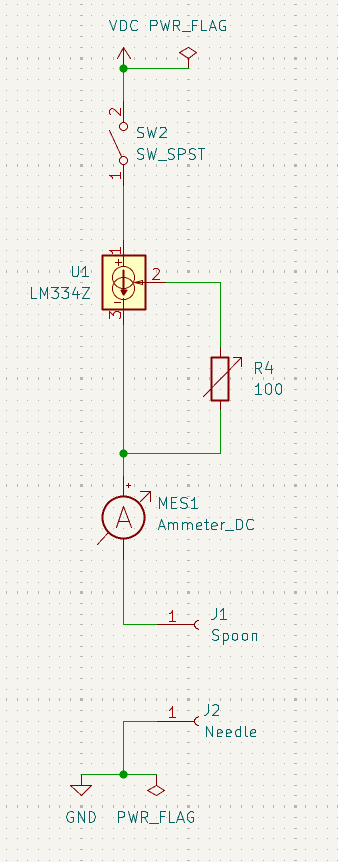
As a voltage source i used a 9V battery. I am thinking of going up to 12V, as there is a drop in current between shorting needle and spoon and using it. The lm334 should keep it constant, but if the resistance is too big for the input voltage there is nothing it can do.
Building & Using #
At first i just tried the lm334 on a breadboard to see how it behaved. This was a good idea as the datasheet shows the pins in bottom view and if you don't read that it is very confusing.
Then i built a first version without a switch. This was bad to use, because the skin got very irritated (red dots for at least a week) when i applied the current to the outside of the skin. This also happened with a switch as i was a bit scared of actually inserting the needle in the beginning. It is helpful to try it without current, just to see how the skin and needle interact.
I didn't solder it yet. I have ordered parts to do that, but already it works and i want to use it more.
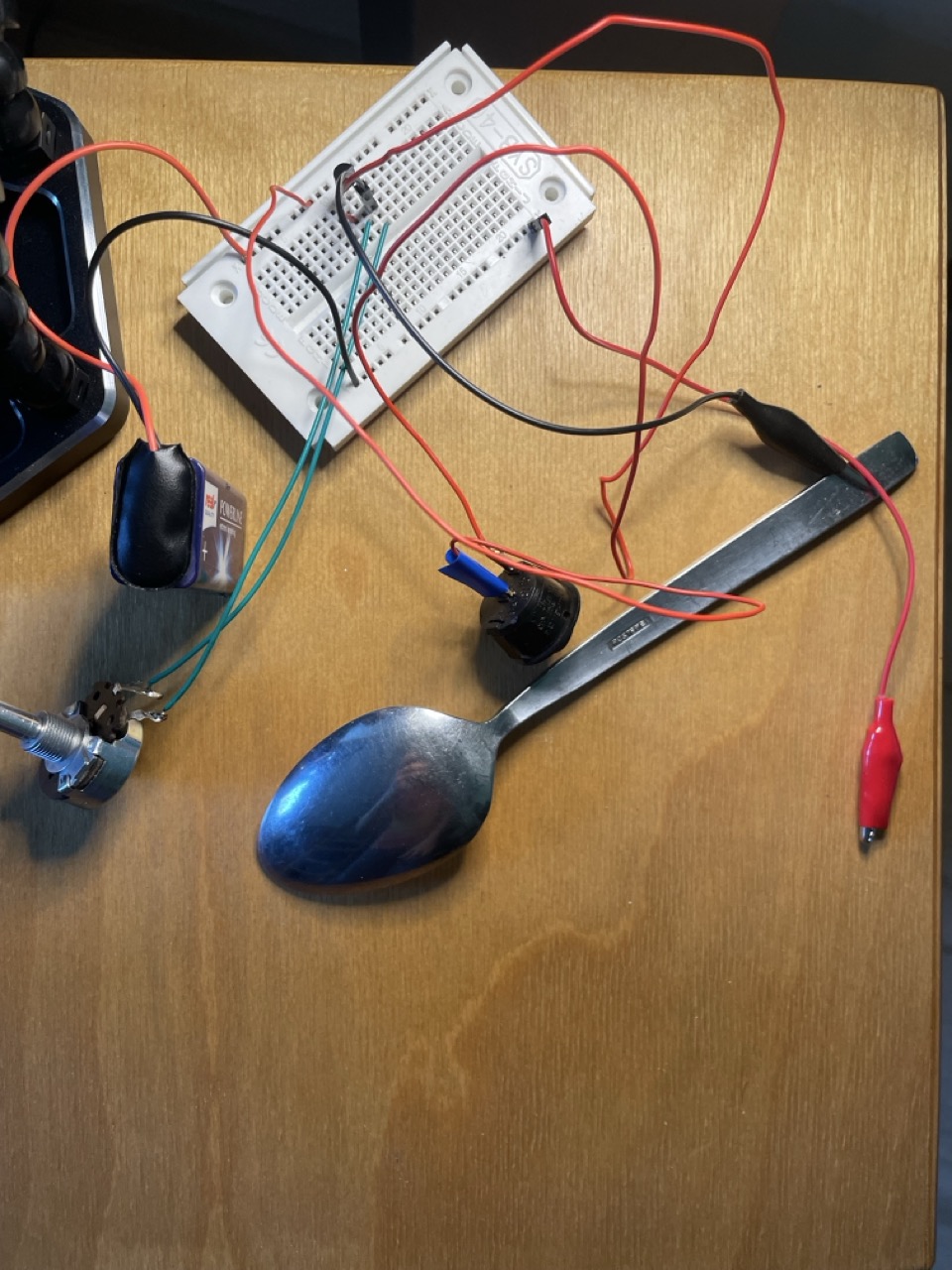
I also still use alligator clips to hold the needle and plan on continuing this. I didn't find it hard to control and the recommended female DE-9 connector pins are actually too big for my needles.
It is pretty easy to use, but very slow. Maybe it will get faster once i have a footswitch as i then don't need to find the tweezers all the time and instead just keep them in my hand. Getting medical pads for electrical connection to the skin could also improve the speed, because i don't have to worry about holding the spoon correctly.
If you do use a spoon you have to hold it pretty tight, to get the resistance low enough. I also found it helpful to hold the spoon with my knee when working on my legs.
The skin irritation is minimal once i started inserting the needle correctly. It just is red for a couple of hours. But i found that while working on my legs sometimes muscles would twitch and i would sometimes get a feeling like my leg was falling asleep. I don't know the reasons for that, but i don't think it is too worrying (or is it??).
At some point i also stopped using the ampere meter, because i basically had the current tuned and i wasn't looking at it while using it anyways.
conclusion #
Do this!! (not medical advice)
At some point i will probably solder it. I got a case for it and i will make all the external parts connect with easily removable wires, so it may even look kind of professional. I will also make a longer wire for the needle alligator clip. Currently it is short and so i have to keep the circuit very close to the place i want to use it.
Update 2026-09-22 #
Over time i noticed some problems, especially in regards to the stability of the current. I mentioned the current drop between short circuit and actually usage, but another issue is that this drop is not consistent over time. In a typical session the current often started at around 0.1mA and then slowly inkreased to around 0.6mA.
I am unsure why this happens, my current theory is that the blood flow inkreases due to pain and stuff? And this then leads to more water in the skin, which reduces the resistance.
This is annoying as i constantly need to monitor the current and i can't actually set it accurately. Also my 9V battery was slowly dying and not able to even reach 0.3mA, which means that i was very slow.
So i wanted to upgrade my power source to a lab power supply. At first i tried a very cheap one, but it was not nice to use. While the circuit was off, so when i was trying to insert the needle, it felt like there was still a small current running. I think the negative electrode of the power supply (which the needle is directly connected to) didn't have a stable voltage and it leaked a bit of the AC power. Because it is AC it can't really get on the same potential as the body, so there is always a small voltage. I don't think it even matters if a current actually runs, since i think the skin is pretty sensitive to voltage as well?
Anyways this was not very good. I also couldn't ground the electrode, because the power supply itself wasn't actually grounded in the outlet. So i switched to a bigger one, which is actually grounded. This turned out to not even be necessary, because the issue didn't occur. It probably is just a better all around power supply and doesn't leak as much AC.
Now i run it at around 18V, which is enough to consistently keep the lm334 limiting the current. This means that i can set my target current while short circuiting and be certain that i actually get that current while using it. Good Stuff!